Design and created by Guideline Central in participation with the American Academy of Family Physicians.
Birth Through Age 18 Immunization Schedule
American Academy of Family Physicians
Publication Date: Sep 9, 2025
Page Last Updated: May 5, 2026
Immunization Schedule Based on Age Group
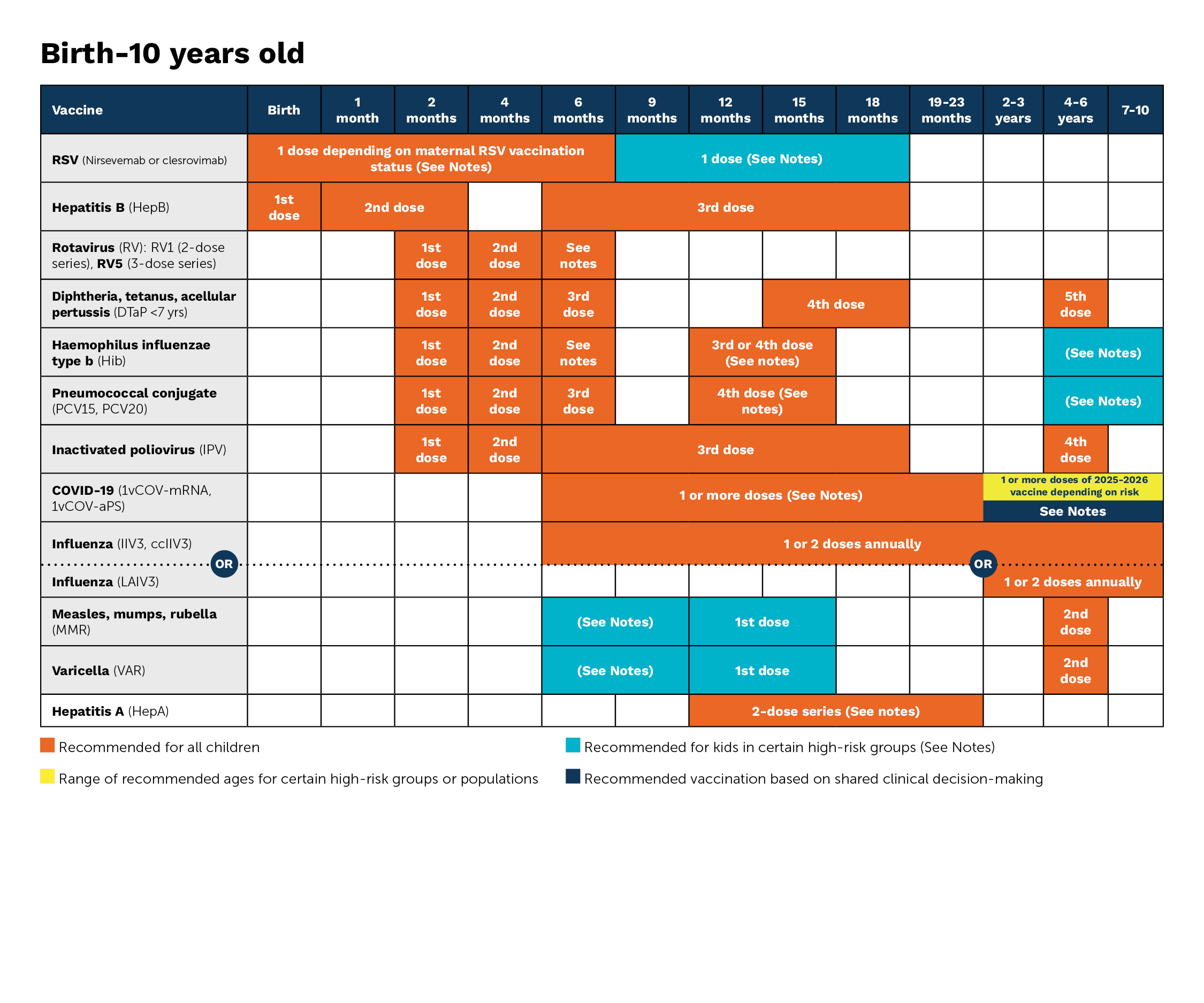
Immunization Schedule - Brith to 10 Years Old
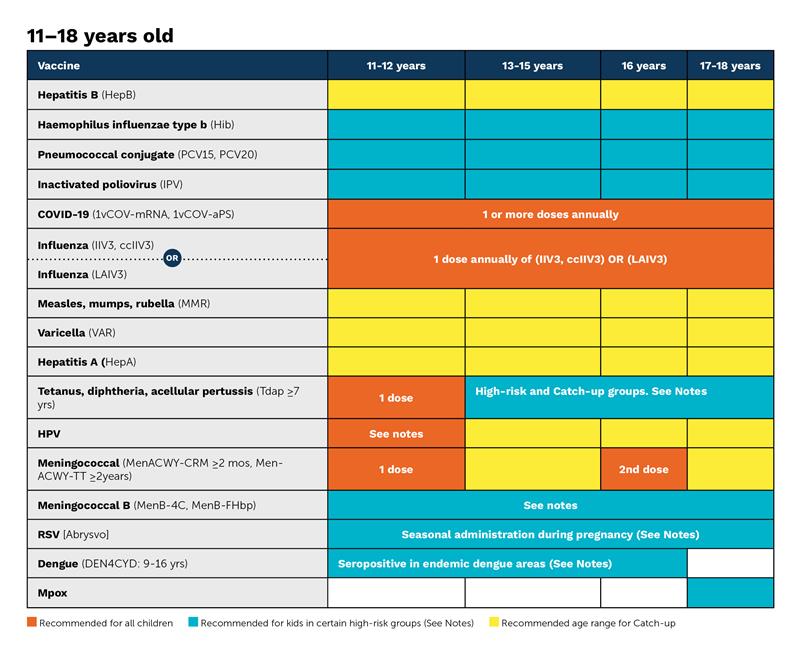
Immunization Schedule - 11 to 18 Years Old
Immunization Schedule Notes
COVID-19
Minimum age: 6 months (Moderna and Pfizer-BioNTech)
Routine Vaccination
Ages 5-11 years
- Unvaccinated: 1 dose 2025-26 Moderna or Pfizer-BioNTech
- Previously vaccinated before 2025-26 vaccine with 1 or more doses Moderna or Pfizer-BioNTech: 1 dose 2025-26 Moderna or Pfizer-BioNTech at least 8 weeks after the most recent dose.
Age 12–18 years
- Unvaccinated:
- 1 dose 2025-26 Moderna or Pfizer-BioNTech
- 2 doses 2025-26 Novavax at 0, 3–8 weeks
- Previously vaccinated before 2025-26 vaccine with:
- 1 or more doses Moderna or Pfizer-BioNTech: 1 dose 2025-26 Moderna or Novavax or Pfizer-BioNTech at least 8 weeks after the most recent dose.
- 1 dose Novavax: 1 dose 2025-26 Novavax 3-8 weeks after most recent dose. If more than 8 weeks after most recent dose, administer 1 dose 2025-26 Moderna or Novavax or Pfizer-BioNTech.
- 2 or more doses Novavax: 1 dose 2025-26 Moderna or Novavax or Pfizer-BioNTech at least 8 weeks after the most recent dose.
Special Situation
Persons who are moderately or severely immunocompromised.
Age 5-11 years
Use vaccine from the same manufacturer for all doses in the initial vaccination series.
- Unvaccinated:
- 4 doses (3-dose initial series 2025-26 Moderna at 0, 4 weeks, and at least 4 weeks after dose 2, followed by 1 dose 2025-26 Moderna or Pfizer-BioNTech 6 months later [minimum interval 2 months]). May administer additional doses.*
- 4 doses (3-dose initial series 2025-26 Pfizer-BioNTech at 0, 3 weeks, and at least 4 weeks after dose 2, followed by 1 dose 2025-26 Moderna or Pfizer-BioNTech 6 months later [minimum interval 2 months]). May administer additional doses.*
- Incomplete initial 3-dose vaccination series before 2025-26 vaccine:
- Previous vaccination with Moderna
- 1 dose Moderna: complete initial series with 2 doses 2025-26 Moderna at least 4 weeks apart (administer dose 1 4 weeks after most recent dose), followed by 1 dose 2025-26 Moderna or Pfizer-BioNTech 6 months later (minimum interval 2 months). May administer additional doses of Moderna or Pfizer-BioNTech.*
- 2 doses Moderna: complete initial series with 1 dose 2025-26 Moderna at least 4 weeks after most recent dose, followed by 1 dose 2025-26 Moderna or Pfizer-BioNTech 6 months later (minimum interval 2 months). May administer additional doses of Moderna or Pfizer-BioNTech.*
- Previous vaccination with Pfizer-BioNTech
- 1 dose Pfizer-BioNTech: complete initial series with 2 doses 2025-26 Pfizer-BioNTech at least 4 weeks apart (administer dose 1 3 weeks after most recent dose), followed by 1 dose 2025-26 Moderna or Pfizer-BioNTech 6 months later (minimum interval 2 months). May administer additional doses of Moderna or Pfizer-BioNTech.*
- 2 doses Pfizer-BioNTech: complete initial series with 1 dose 2025-26 Pfizer-BioNTech at least 4 weeks after most recent dose, followed by 1 dose 2025-26 Moderna or Pfizer-BioNTech 6 months later (minimum interval 2 months). May administer additional doses of Moderna or Pfizer-BioNTech.*
- Previous vaccination with Moderna
- Completed initial 3-dose vaccination series before 2025-26 vaccine with:
- 3 or more doses Moderna or 3 or more doses Pfizer-BioNTech: 2 doses 2025-26 Moderna or Pfizer-BioNTech 6 months apart (minimum interval 2 months). Administer dose 1 at least 8 weeks after the most recent dose. May administer additional doses of Moderna or Pfizer-BioNTech.*
Age 12-18 years
Use vaccine from the same manufacturer for all doses in the initial vaccination series.
- Unvaccinated:
- 4 doses (3-dose initial series Moderna at 0, 4 weeks, and at least 4 weeks after dose 2, followed by 1 dose 2025-26 Moderna or Novavax or Pfizer-BioNTech 6 months later [minimum interval 2 months]). May administer additional doses of Moderna or Novavax or Pfizer-BioNTech.*
- 4 doses (3-dose initial series Pfizer-BioNTech at 0, 3 weeks, and at least 4 weeks after dose 2, followed by 1 dose 2025-26 Moderna or Novavax or Pfizer-BioNTech 6 months later [minimum interval 2 months]). May administer additional doses of Moderna or Novavax or Pfizer-BioNTech.*
- 3 doses (2-dose initial series Novavax at 0, 3 weeks, followed by 1 dose Moderna or Novavax or Pfizer-BioNTech 6 months later [minimum interval 2 months]). May administer additional doses of Moderna or Novavax or Pfizer-BioNTech.*
- Incomplete initial vaccination series before 2025-26 vaccine:
- Previous vaccination with Moderna
- 1 dose Moderna: complete initial series with 2 doses 2025-26 Moderna at least 4 weeks apart (administer dose 1 4 weeks after most recent dose), followed by 1 dose 2025-26 Moderna or Novavax or Pfizer-BioNTech 6 months later (minimum interval 2 months). May administer additional doses of Moderna or Novavax or Pfizer-BioNTech.*
- 2 doses Moderna: complete initial series with 1 dose 2025-26 Moderna at least 4 weeks after most recent dose, followed by 1 dose 2025-26 Moderna or Novavax or Pfizer-BioNTech 6 months later (minimum interval 2 months). May administer additional doses of Moderna or Novavax or Pfizer-BioNTech.*
- Previous vaccination with Moderna
- Previous vaccination with Pfizer-BioNTech
- 1 dose Pfizer-BioNTech: complete initial series with 2 doses 2025-26 Pfizer-BioNTech at least 4 weeks apart (administer dose 1 3 weeks after most recent dose), followed by 1 dose 2025-26 Moderna or Novavax or Pfizer-BioNTech 6 months later (minimum interval 2 months). May administer additional doses of Moderna or Novavax or Pfizer-BioNTech.*
- 2 doses Pfizer-BioNTech: complete initial series with 1 dose 2025-26 Pfizer-BioNTech at least 4 weeks after most recent dose, followed by 1 dose 2025-26 Moderna or Novavax or Pfizer-BioNTech 6 months later (minimum interval 2 months). May administer additional doses of Moderna or Novavax or Pfizer-BioNTech.*
- Previous vaccination with Novavax
- 1 dose Novavax: complete initial series with 1 dose 2025-26 Novavax at least 3 weeks after most recent dose, followed by 1 dose 2025-26 Moderna or Novavax or Pfizer-BioNTech 6 months later (minimum interval 2 months). May administer additional doses of Moderna or Novavax or Pfizer-BioNTech.*
- Completed initial 3-dose vaccination series before 2025-26 vaccine with:
- 3 or more doses Moderna or 3 or more doses Pfizer-BioNTech: 2 doses 2025-26 Moderna or Novavax or Pfizer-BioNTech 6 months apart (minimum interval 2 months). Administer dose 1 at least 8 weeks after the most recent dose. May administer additional doses of Moderna or Novavax or Pfizer-BioNTech.*
- 2 or more doses Novavax: 2 doses 2025-26 Moderna or Novavax or Pfizer-BioNTech 6 months apart (minimum interval 2 months). Administer dose 1 at least 8 weeks after the most recent dose. May administer additional doses of Moderna or Novavax or Pfizer-BioNTech.*
*Additional doses of 2025-26 COVID-19 vaccine for moderately or severely immunocompromised: based on shared clinical decision-making and administered at least 2 months after the most recent dose (see Catch-up Schedule).
Unvaccinated persons have never received any COVID-19 vaccine doses. There is no preferential recommendation for the use of one COVID-19 vaccine over another when more than one recommended age-appropriate vaccine is available. Administer an age-appropriate COVID-19 vaccine product for each dose.
Dengue
Minimum Age: 3 years
Routine Vaccination
- Age 9-16 years living in areas with endemic dengue AND have laboratory confirmation of previous dengue infection
- 3-dose series administered at 0, 6, and 12 months
- Endemic areas include Puerto Rico, American Samoa, US Virgin Islands, Federated States of Micronesia, Republic of Marshall Islands, and the Republic of Palau.
- Dengue vaccine should not be administered to children traveling to or visiting endemic dengue areas.
Hepatitis A (HepA)
Routine vaccination
2-dose series (minimum interval: 6 months) at age 12–23 months
Catch-up vaccination
- Unvaccinated persons through age 18 years should complete a 2-dose series (minimum interval: 6 months).
- Persons who previously received 1 dose at age 12 months or older should receive dose 2 at least 6 months after dose 1.
- Adolescents age 18 years or older may receive HepA-HepB (Twinrix) as a 3-dose series (0, 1, and 6 months) or 4-dose series (3 doses at 0, 7, and 21–30 days, followed by a booster dose at 12 months).
International travel
- Persons traveling to or working in countries with high or intermediate endemic hepatitis A:
- Unvaccinated age 12 months or older: Administer dose 1 as soon as travel is considered.
Hepatitis B
Catch-up Vaccination
- Unvaccinated persons should complete a 3-dose series at 0, 1-2, 6 months. See Catch-up Schedule for minimum intervals.
- Adolescents age 11-15 years may use an alternative 2-dose schedule with at least 4 months between doses (adult formulation Recombivax HB only).
- Adolescents age 18 years may receive:
- Heplisav-B: 2-dose series at least 4 weeks apart
- PreHevbrio*: 3-dose series at 0, 1, and 6 months
- HepA-HepB (Twinrix): 3-dose series (0, 1, and 6 months) or 4-dose series (3 doses at 0, 7, and 21-30 days, followed by a booster dose at 12 months).
Special Situations
- Revaccination is generally not recommended for persons with a normal immune status who were vaccinated as infants, children, adolescents, or adults.
- Post-vaccination serology testing and revaccination (if anti-HBs <10mlU/mL) is recommended for certain populations, including:
- Infants born to HBsAg-positive mothers
- Persons who are predialysis or on maintenance dialysis
- Other immunocompromised persons
*Note: PreHevbrio is not recommended in pregnancy due to lack of safety data in pregnant persons.
Haemophilus Influenzae Type B
Catch-up Vaccination
- Previously unvaccinated children age 60 months or older who are not considered high risk: Catch-up vaccination not required.
Special Situations
- Hematopoietic stem cell transplant (HSCT):
- 3-dose series 4 weeks apart starting 6 to 12 months after successful transplant, regardless of Hib vaccination history
- Anatomic or functional asplenia (including sickle cell disease): Age 12-59 months
- Unvaccinated or only 1 dose before age 12 months: 2 doses, 8 weeks apart
- 2 or more doses before age 12 months: 1 dose at least 8 weeks after previous dose
- Unvaccinated* persons age 5 years or older
- 1 dose
- Elective splenectomy:
Unvaccinated* persons age 15 months or older- 1 dose (preferably at least 14 days before procedure)
- HIV infection: Age 12-59 months
- Unvaccinated* persons age 5-18 years:
- 1 dose
- Unvaccinated* persons age 5-18 years:
* Unvaccinated = Less than routine series (through age 14 months) or no doses (age 15 months or older)
HPV
Minimum Age: 9 years
Routine and catch-up vaccination
- HPV vaccination routinely recommended at age 11-12 years (can start at age 9 years) and catch-up HPV vaccination recommended for all persons through age 18 years if not adequately vaccinated.
- 2- or 3-dose series depending on age at initial vaccination:
- Age 9-14 years at initial vaccination: 2-dose series at 0, 6-12 months (minimum interval: 5 months; repeat dose if administered too soon)
- Age 15 years or older at initial vaccination: 3-dose series at 0, 1-2 months, 6 months (minimum intervals: dose 1 to dose 2 = 4 weeks; dose 2 to dose 3 = 12 weeks; dose 1 to dose 3 = 5 months; repeat dose if administered too soon)
- No additional dose recommended when any HPV vaccine series of any valency has been completed using recommended dosing intervals.
Special situations
- Immunocompromising conditions, including HIV infection: 3-dose series, even for those who initiate vaccination at age 9 through 14 years.
- History of sexual abuse or assault: Start at age 9 years
- Pregnancy: Pregnancy testing not needed before vaccination; HPV vaccination not recommended until after pregnancy; no intervention needed if vaccinated while pregnant.
Inactivated Poliovirus (IPV)
Special situations
Adolescents aged 18 years at increased risk of exposure to poliovirus and completed primary series*: may administer one lifetime IPV booster
*Note: Complete primary series consist of at least 3 doses of IPV or trivalent oral poliovirus vaccine (tOPV) in any combination.
Influenza
Minimum Age:
- 6 months [IIV3],
- 2 years [LAIV3]
- 9 years [recombinant influenza vaccine, Flublok RIV3]
Routine Vaccination
All marketed U.S. vaccines are trivalent this season (2025-26)
Age 18 years solid organ transplant recipients receiving immunosuppressive medications: high-dose inactivated (HD-IIV3) and adjuvanted inactivated (aIIV3) influenza vaccines are acceptable options. No preference over other age-appropriate IIV3 or RIV3.
Special Situations
Close contacts (e.g., household contacts) of severely immunosuppressed persons who require a protected environment: should not receive LAIV3. If LAIV3 is given, they should avoid contact with, or caring for such immunosuppressed persons for 7 days after vaccination.
Note: Persons with an egg allergy can receive any influenza vaccine (egg-based or non-egg based) appropriate for age and health status.
Measles, Mumps, Rubella (MMR)
Minimum Age: 12 Months for routine vaccination
Catch-up Vaccination
- Unvaccinated children and adolescents: 2-dose series at least 4 weeks apart*
- The maximum age for use of MMRV* is 12 years.
Special Situations
- International travel
- Children age 12 months or older:
- Unvaccinated: 2-dose series (separated by at least 4 weeks*) before departure
- Previously received 1 dose: administer dose 2 at least 4 weeks after dose 1*
- Children age 12 months or older:
- In mumps outbreak settings, for information about additional doses of MMR (including 3rd dose of MMR)
*Note: If MMRV is used, the minimum interval between MMRV doses is 3 months.
Meningococcal Serogroup A, C, W, Y
Minimum Age:
- 2 months [MenACWY-CRM, Menveo]
- 2 years [MenACWY-TT, MenQuadfi],
- 10 years [MenACWY-TT/MenB-FHbp, Penbraya]
Routine Vaccination
2-dose series at age 11–12 years; 16 years
Catch-up Vaccination
- Age 13–15 years: 1 dose now and booster at age 16–18 years (minimum interval: 8 weeks)
- Age 16–18 years: 1 dose
Special situations
Anatomic or functional asplenia (including sickle cell disease), HIV infection, persistent complement component deficiency, complement inhibitor (e.g., eculizumab, ravulizumab) use:
- Menveo*
- Dose 1 at age 24 months or older: 2-dose series at least 8 weeks apart
- MenQuadfi
- Dose 1 at age 24 months or older: 2-dose series at least 8 weeks apart
Travel to countries with hyperendemic or epidemic meningococcal disease, including countries in the African meningitis belt or during the Hajj:
Children age 2 years or older: 1 dose Menveo* or MenQuadfi
Meningococcal Serogroup B
Minimum Age:
10 years [MenB-4C, Bexsero; MenB-FHbp, Trumenba; MenACWY-TT/MenB-FHbp, Penbraya]
Shared Clinical Decision-making
- Adolescents not at increased risk age 16-23 years (preferred age 16-18 years)* based on shared clinical decision-making.
- Bexsero or Trumenba (use same brand for all doses): 2-dose series at least 6 months apart (if dose 2 is administered earlier than 6 months, administer dose 3 at least 4 months after dose 2)
*To optimize rapid protection (e.g., for students starting college in less than 6 months), a 3-dose series (0, 1-2, 6 months) may be administered.
Special Situations
Anatomic or functional asplenia (including sickle cell disease), persistent complement component deficiency, complement inhibitor (e.g., eculizumab, ravulizumab) use.
- Bexsero or Trumenba (use same brand for all doses including booster doses) 3-dose series at 0, 1-2, 6 months (if dose 2 was administered at least 6 months after dose 1, dose 3 not needed; if dose 3 is administered earlier than 4 months after dose 2, a 4th dose should be administered at least 4 months after dose 3)
Note: MenB vaccines may be administered simultaneously with MenACWY vaccines if indicated, but at a different anatomic site, if feasible.
Children age 10 years or older may receive a dose of Penbraya (MenACWY-TT/MenB-FHbp) as an alternative to separate administration of MenACWY and MenB when both vaccines would be given on the same clinic day. For age-eligible children not at increased risk, if Penbraya is used for dose 1 MenB, MenB-FHbp (Trumenba) should be administered for dose 2 MenB. For age-eligible children at increased risk of meningococcal disease, Penbraya may be used for additional MenACWY and MenB doses (including booster doses) if both would be given on the same clinic day and at least 6 months have elapsed since most recent Penbraya dose.
Mpox Jynneos
Minimum Age: 18 years
Special Situations
- Age 18 years and at risk for mpox infection: complete 2-dose series, 28 days apart. Risk factors for mpox infection include:
- Persons who are gay, bisexual, and other MSM, transgender or nonbinary people who in the past 6 months have had:
- A new diagnosis of at least 1 sexually transmitted disease
- More than 1 sex partner
- Sex at a commercial sex venue
- Sex in association with a large public event in a geographic area where mpox transmission is occurring
- Persons who are sexual partners of the persons described above
- Persons who anticipate experiencing any of the situations described above
- Persons who are gay, bisexual, and other MSM, transgender or nonbinary people who in the past 6 months have had:
- Pregnancy: There is currently no ACIP recommendation for Jynneos use in pregnancy due to lack of safety data in pregnant persons. Pregnant persons with any risk factor described above may receive Jynneos.
Pneumococcal Conjugate
Special situations
Children and adolescents with cerebrospinal fluid leak; chronic heart disease; chronic kidney disease (excluding maintenance dialysis and nephrotic syndrome); chronic liver disease; chronic lung disease (including moderate persistent or severe persistent asthma); cochlear implant; or diabetes mellitus:
Age 6-18 years
- Not previously received any dose of PCV13, PCV15, or PCV20: administer 1 dose of PCV15 or PCV20. If PCV15 is used and no previous receipt of PPSV23, administer 1 dose of PPSV23 at least 8 weeks after the PCV15 dose.**
- Received PCV before age 6 years but have not received PPSV23
- Previously received at least 1 dose of PCV20: no further PCV or PPSV23 doses needed
- Not previously received PCV20: 1 dose PCV20 or 1 dose PPSV23 administer at least 8 weeks after the most recent PCV dose.
- Received PCV13 only at or after age 6 years: administer 1 dose PCV20 or 1 dose PPSV23 at least 8 weeks after the most recent PCV13 dose.
- Received 1 dose PCV13 and 1 dose PPSV23 at or after age 6 years: no further doses of any PCV or PPSV23 indicated.
Children and adolescents on maintenance dialysis, or with immunocompromising conditions such as nephrotic syndrome; congenital or acquired asplenia or splenic dysfunction; congenital or acquired immunodeficiencies; diseases and conditions treated with immunosuppressive drugs or radiation therapy, including malignant neoplasms, leukemias, lymphomas, Hodgkin disease, and solid organ transplant; HIV infection; or sickle cell disease or other hemoglobinopathies:
Age 6-18 years
- Not previously received any dose of PCV13, PCV15, or PCV20: administer 1 dose of PCV15 or 1 dose of PCV20. If PCV15 is used and no previous receipt of PPSV23, administer 1 dose of PPSV23 at least 8 weeks after the PCV15 dose.**
- Received PCV before age 6 years but have not received PPSV23
- Previously received at least 1 dose of PCV20: no additional dose of PCV or PPSV23
- Not previously received PCV20: administer 1 dose PCV20 or 1 dose PPSV23 at least 8 weeks after the most recent PCV dose. If PPSV23 is used, administer either PCV20 or dose 2 PPSV23 at least 5 years after dose 1 PPSV23.
- Received PCV13 only at or after age 6 years: administer 1 dose PCV20 or 1 dose PPSV23 at least 8 weeks after the most recent PCV13 dose. If PPSV23 is used, administer 1 dose of PCV20 or dose 2 PPSV23 at least 5 years after dose 1 PPSV23.
- Received 1 dose PCV13 and 1 dose PPSV23 at or after age 6 years: administer 1 dose PCV20 or 1 dose PPSV23 at least 8 weeks after the most recent PCV13 dose and at least 5 years after dose 1 PPSV23.
Pregnancy: No recommendation for PCV or PPSV23 due to limited data.
*Incomplete series = Not having received all doses in either the recommended series or an age-appropriate catch-up series.
**When both PCV15 and PPSV23 are indicated, administer all doses of PCV15 first. PCV15 and PPSV23 should not be administered during the same visit. 3 PCV doses: 1 dose PCV (at least 8 weeks after the most recent PCV dose)
RSV: Abrysvo
Routine Immunization
- Pregnant at 32 weeks 0 days through 36 weeks and 6 days gestation from September through January in most of the continental United States*: 1 dose Abrysvo. Administer RSV vaccine regardless of previous RSV infection.
- Either maternal RSV vaccination with Abrysvo or infant immunization with nirsevimab (RSV monoclonal antibody) is recommended to prevent severe respiratory syncytial virus disease in infants.
- All other pregnant persons: RSV vaccine not recommended
- Subsequent pregnancies: Additional doses not recommended. No data are available to inform whether additional doses are needed in subsequent pregnancies. Infants born to pregnant persons who received RSV vaccine during a previous pregnancy should receive nirsevimab.
*Note: Providers in jurisdictions with RSV seasonality that differs from most of the continental United States (e.g., Alaska, jurisdictions with tropical climate) should follow guidance from public health authorities (e.g., health departments) or regional medical centers on timing of administration based on local RSV seasonality.
Tetanus, Diphtheria, Acellular Pertussis
Minimum Age:
- 11 years for routine vaccination
- 7 years for catch-up vaccination
Routine vaccination
- Age 11-12 years: 1 dose Tdap (adolescent booster)
- Pregnancy: 1 dose Tdap during each pregnancy, preferably in early part of gestational weeks 27-36
Note: Tdap may be administered regardless of the interval since the last tetanus- and diphtheria-toxoid-containing vaccine.
Catch-up vaccination
- Age 13-18 years who have not received Tdap: 1 dose Tdap (adolescent booster)
- Age 7-18 years not fully vaccinated* with DTaP: 1 dose Tdap as part of the catch-up series (preferably the first dose); if additional doses are needed, use Td or Tdap.
- Tdap administered at age 7-10 years:
- Age 7-9 years who receive Tdap should receive the adolescent Tdap booster dose at age 11-12 years
- Age 10 years who receive Tdap do not need the adolescent Tdap booster dose at age 11-12 years
- DTaP inadvertently administered on or after age 7 years:
- Age 7-9 years: DTaP may count as part of catch-up series. Administer adolescent Tdap booster dose at age 11-12 years.
- Age 10-18 years: Count dose of DTaP as the adolescent Tdap booster dose.
- For other catch-up guidance, see Catch-up Schedule.
Special Situations
Wound management in persons age 7 years or older with history of 3 or more doses of tetanus-toxoid-containing vaccine: For clean and minor wounds, administer Tdap or Td if more than 10 years since last dose of tetanus-toxoid-containing vaccine; for all other wounds, administer Tdap or Td if more than 5 years since last dose of tetanus-toxoid-containing vaccine. Tdap is preferred for persons age 11 years or older who have not previously received Tdap or whose Tdap history is unknown. If a tetanus-toxoid-containing vaccine is indicated for a pregnant adolescent, use Tdap.
*Fully vaccinated = 5 valid doses of DTaP or 4 valid doses of DTaP if dose 4 was administered at age 4 years or older
Varicella
Minimum Age: 12 months
Routine Vaccination
- 2-dose series at age 12-15 months, 4-6 years
- VAR or MMRV may be administered*
- Dose 2 may be administered as early as 3 months after dose 1 (a dose inadvertently administered after at least 4 weeks may be counted as valid).
*Note: For dose 1 in children age 12-47 months, it is recommended to administer MMR and varicella vaccines separately. MMRV may be used if parents or caregivers express a preference.
Catch-up vaccination
- Ensure persons age 7-18 years without evidence of immunity have a 2-dose series:
- Age 7-12 years: Routine interval: 3 months (a dose inadvertently administered after at least 4 weeks may be counted as valid)
- Age 13 years and older: Routine interval: 4-8 weeks (minimum interval: 4 weeks)
The maximum age for use of MMRV is 12 years.
Immunization Catch-Up Schedule
Catch-Up Schedule
|
Children Ages 4 months Through 6 years
| |||||
| Minimum Interval Between Doses | |||||
| Vaccine | Min Age for Dose 1 | Dose 1 to 2 | Dose 2 to 3 | Dose 3 to 4 | Dose 4 to 5 |
| Hepatitis B | Birth | 4 Weeks | 8 weeks and at least 16 weeks after first dose; minimum age for the final dose is 24 weeks | ||
| Rotavirus | 6 weeks; maximum age for first dose is 14 weeks, 6 days. | 4 weeks | 4 weeks; maximum age for final dose is 8 months, 0 days | ||
| Diphtheria, tetanus, and acellular pertussis | 6 weeks | 4 weeks | 4 weeks | 6 monhts | 6 months; 5th dose is not necessary if the fourth dose was administered at age 4 years or older and at least 6 months after dose 3 |
| Haemophilus influenzae type b | 6 weeks | No further doses needed if first dose was administered at age 15 months or older. 4 weeks if first dose was administered before the 1st birthday. 8 weeks (as final dose) if first dose was administered at age 12 through 14 months. | No further doses needed if previous dose was administered at age 15 months or older 4 weeks if current age is younger than 12 months and first dose was administered at younger than age 7 months and at least 1 previous dose was PRP-T (ActHib, Pentacel, Hiberix), Vaxelis or unknown 8 weeks and age 12 through 59 months (as final dose) if: current age is younger than 12 months and first dose was administered at age 7 through 11 months; OR if current age is 12 through 59 months and first dose was administered before the 1st birthday and second dose was administered at younger than 15 months; OR if both doses were PedvaxHIB and were administered before the 1st birthday | 8 weeks (as final dose). This dose only necessary for children age 12 through 59 months who received 3 doses before the 1st birthday. | |
| Pneumococcal conjugate | 6 Weeks | No further doses needed for healthy children if first dose was administered at age 24 months or older 4 weeks if first dose was administered before the 1st birthday 8 weeks (as final dose for healthy children) if first dose was administered at the 1st birthday or after | No further doses needed for healthy children if previous dose was administered at age 24 months or older 4 weeks if current age is younger than 12 months and previous dose was administered at <7 months old 8 weeks (as final dose for healthy children) if previous dose was administered between 7-11 months (wait until at least 12 months old); OR if current age is 12 months or older and at least 1 dose was administered before age 12 months | 8 weeks (as final dose); This dose is only necessary for children age 12 through 59 months regardless of risk, or age 60 through 71 months with any risk, who received 3 doses before age 12 months. | |
| Inactivated poliovirus | 6 weeks | 4 weeks | 4 weeks if current age is <4 years | 6 months (minimum age 4 years for final dose) | |
| Measles, mumps, rubella | 12 months | 4 weeks | |||
| Varicella | 12 months | 3 months | |||
| Hepatitis A | 12 months | 6 months | |||
| Meningococcal ACWY | 2 months MenACWY-CRM 2 years MenACWY-TT | 8 weeks | See Notes | See notes | |
| Children and adolescents age 7 through 18 years | |||||
| Meningococcal ACWY | N/A | 8 Weeks | |||
| Tetanus, diphtheria; tetanus, diphtheria, and acellular pertussis | 7 years | 4 Weeks | 4 weeks if first dose of DTaP/DT was administered before the 1st birthday 6 months (as final dose) if first dose of DTaP/DT or Tdap/Td was administered at or after the 1st birthday | 6 months if first dose of DTaP/DT was administered before the 1st birthday | |
| HPV | 9 years | Routine dosing intervals are recommended. | |||
| Hepatitis A | N/A | 6 months | |||
| Hepatitis B | N/A | 4 weeks | * weeks and at least 16 weeks after first dose | ||
| Inactivated poliovirus | N/A | 4 weeks | 6 months; A fourth dose is not necessary if the third dose was administered at age 4 years or older and at least 6 months after the previous dose. | fourth dose of IPV is indicated if all previous doses were administered at <4 years OR if the third dose was administered <6 months after the second dose. | |
| Measles, mumps, rubella | N/A | 4 weeks | |||
| Varicella | N/A | 3 months if younger than age 13 years. 4 weeks if age 13 years or older | |||
| Dengue | 6 months | 6 months | |||
Immunization Schedule Based on Medical Indication
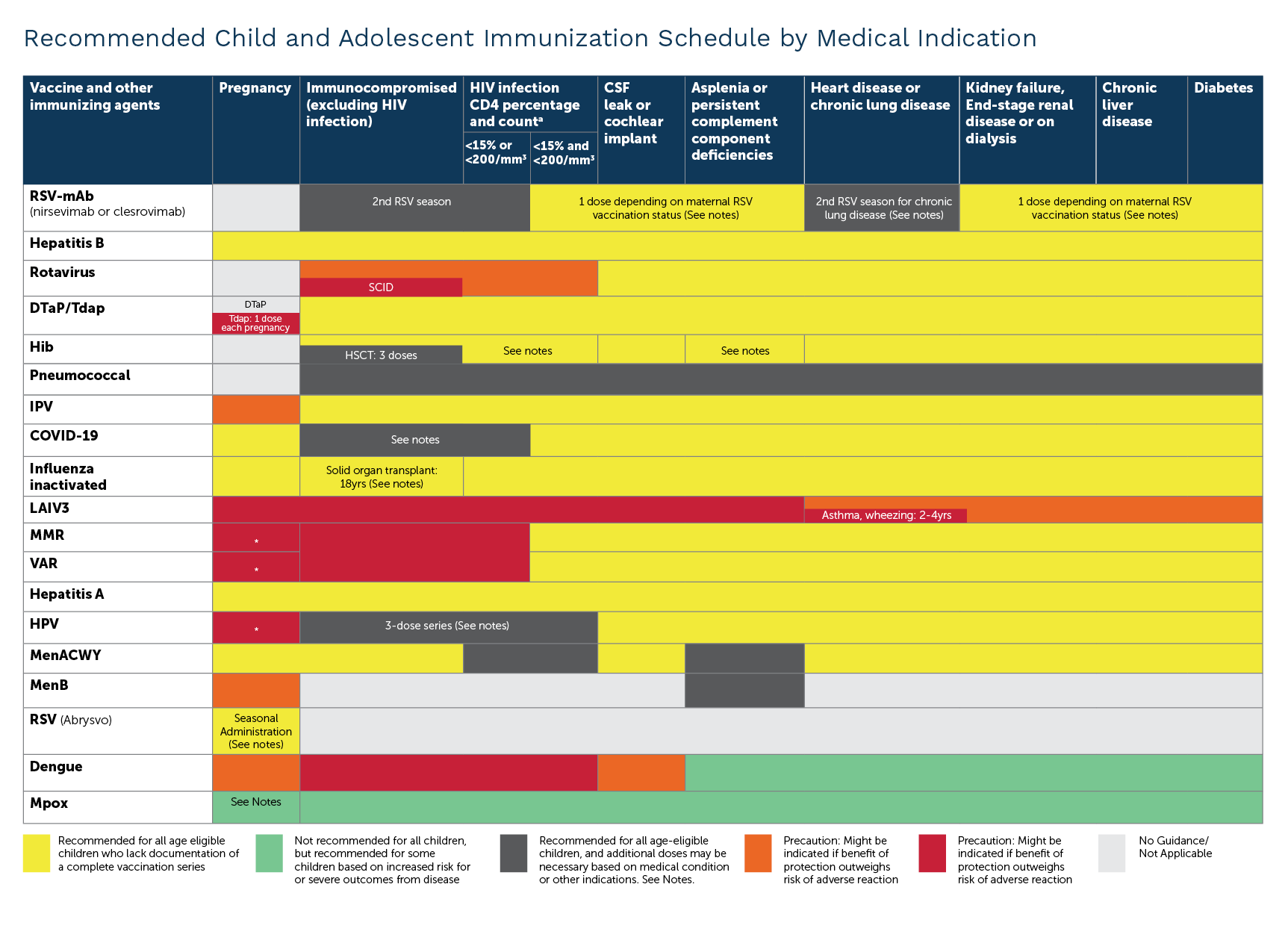
Recommended Child and Adolescent Immunization Schedule by Medical Indication
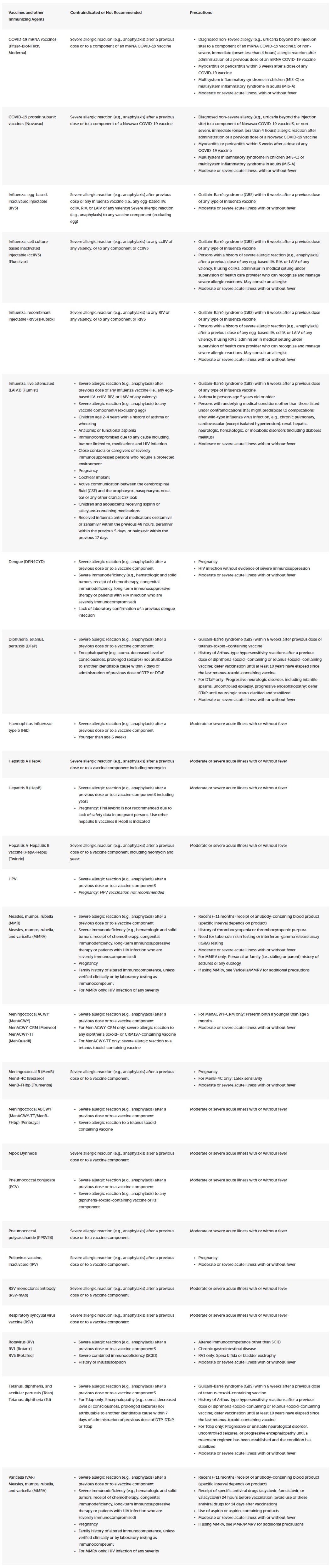
Contraindications and Precautions to Commonly Used Vaccines
Contraindications and Precautions to Commonly Used Vaccines
Document Overview
- Document Title
- Birth Through Age 18 Immunization Schedule
- Authoring Society
- Document Publication Date
- Sep 9, 2025
- Page Last Reviewed/Updated
- May 5, 2026
- Document Type
- Consensus Statement
- Country of Publication
- United States
- Full Text Freely Available
- Yes
Document Scope, Criteria, and Use Cases
- Scope
- Management, Prevention
- Diseases/Conditions (MeSH)
D007114 - Immunization
D007115 - Immunization Schedule
D007114 - Immunization
D007115 - Immunization Schedule
- Keywords
- childhood immunizations, immunization, immunization schedule
- Inclusion Criteria
- Male, Female, Adolescent, Adult, Infant
- Health Care Settings
- Ambulatory
- Intended Users
- Nurse, Nurse Practitioner, Physician, Physician Assistant
Guideline Central and select third party use “cookies” on this website to enhance the user experience.
This technology helps us gather statistical and analytical information to optimize the relevant content for you.
The user also has the option to opt-out which may have an effect on the browsing experience.