Management of Patients With Ventricular Arrythmias and the Prevention of Sudden Cardiac Death
American College of Cardiology, American Heart Association, Heart Rhythm SocietyPublished: December 19, 2018
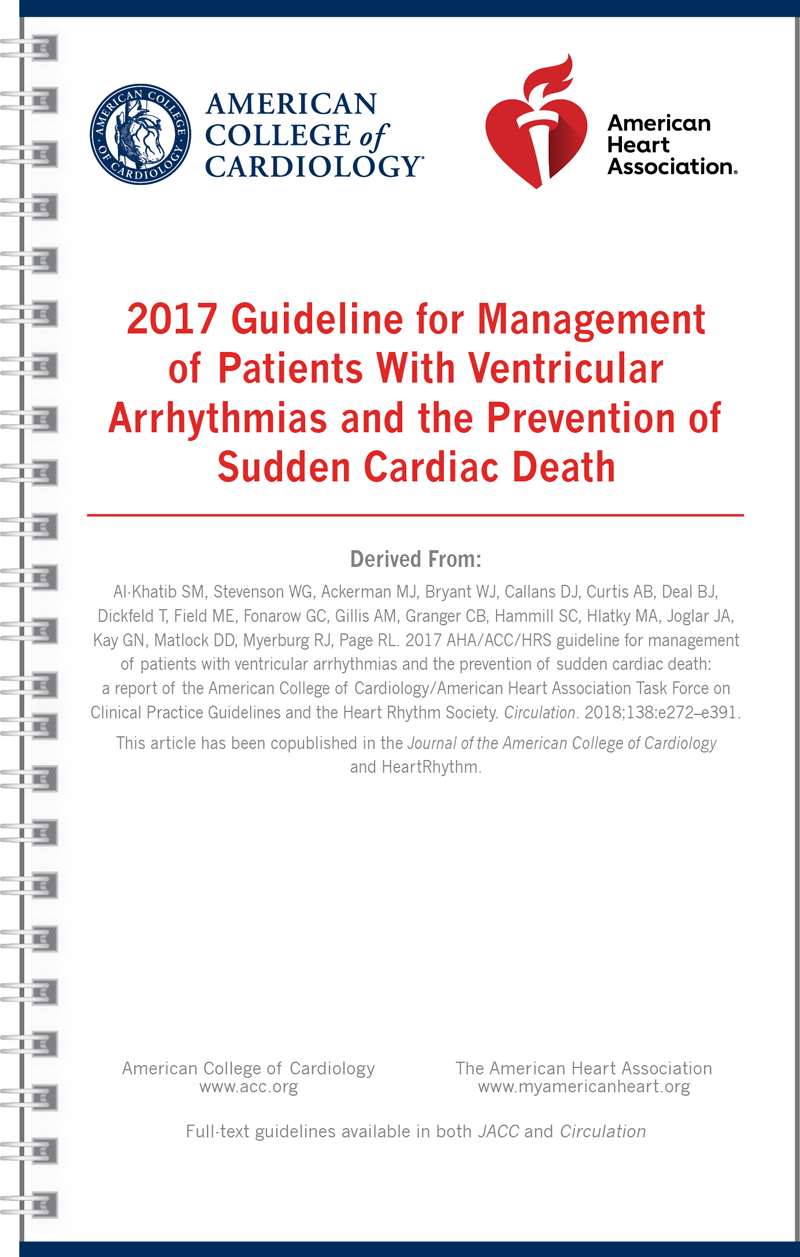
- Graded recommendations for:
- Syncope
- 12-lead ECG and Exercise Testing
- Ambulatory Electrocardiography
- Implanted Cardiac Monitors
- Noninvasive Cardiac Imaging
- Assessment
- Genetic Counselling
- Invasive Imaging: Cardiac Catheterization
- Electrophysiological Study
- Pharmacological Prevention of SCD
- Surgery and Revascularization Procedures in Patients With Ischemic Heart Disease
- Surgery for Arrhythmia Management
- Autonomic Modulation
- Management of Cardiac Arrest
- Secondary Prevention of SCD in Patients with Ischemic Heart Disease
- Coronary Artery Spasm
- Primary Prevention of SCD in Patients with Ischemic Heart Disease
- Recurrent VA in Patients With Ischemic Heart Disease
- Nonischemic Cardiomyopathy (NICM)
- Secondary Prevention of SCD in Patients With NICM
- Primary Prevention of SCD in Patients With NICM
- Treatment of Recurrent VA in Patients With NICM
- Arrhythmogenic Right Ventricular Cardiomyopathy
- Hypertrophic Cardiomyopathy (HCM)
- Myocarditis
- Cardiac Sarcoidosis
- HFr EF
- LVAD
- ICD Use After Heart Transplantation
- Neuromuscular Disorders
- Cardiac Channelopathies
- Congenital Long QT Syndrome
- Catecholaminergic Polymorphic Ventricular Tachycardia
- Brugada Syndrome
- Early Repolarization “J-wave” Syndrome
- Short QT Syndrome
- VA in the Structurally Normal Heart
- Outflow Tract VA
- Papillary Muscle VA (PVCs and VT)
- Interfascicular Reentrant VT (Belhassen Tachycardia)
- Idiopathic Polymorphic VT/VF
- PVC-Induced Cardiomyopathy
- Pregnancy
- Older Patients With Comorbidities
- Medication-Induced Arrhythmias
- Adult Congenital Heart Disease
- Subcutaneous Implantable Cardioverter-Defibrillator
- Wearable Cardioverter-Defibrillator
- Catheter Ablation
- Postmortem Evaluation of SCD
- Terminal Care
- Shared Decision-Making
- Tables
- Table of Definitions of Commonly Used Terms in this Document
- Important Considerations in the Evaluation of Patients With Known or Suspected VA
- Pharmacological Characteristics of Available Antiarrhythmic Medications for Treating VA
- Major Clinical Features Associated With Increased Risk of SCD in Patients With HCM
- Neuromuscular Disorders Associated With Heart Disease
- Commonly Used QT-Prolonging Medications
- Congenital Heart Disease: Risk Factors for VA/SCD
- Figures
- SCD Incidence and Total Events
- SCD and Clinical Subsets
- Long-QT Syndrome Type 1 (ECG)
- Long-QT Syndrome Type 2 (ECG)
- Long-QT Syndrome Type 3 (ECG)
- Exercise-Induced Polymorphic VT in Catecholaminergic Polymorphic Ventricular Tachycardia (ECG)
- Brugada Syndrome (ECG)
- Incremental Cost-Effectiveness of ICD by Years of Life Added (Example)
- Algorithms
- Management of Sustained Monomorphic VT
- Secondary Prevention in Patients With Ischemic Heart Disease
- Primary Prevention of SCD in Patients With Ischemic Heart Disease
- Treatment of Recurrent VA in Patients With Ischemic Heart Disease or NICM
- Secondary and Primary Prevention of SCD in Patients With NICM
- Prevention of SCD in Patients With HCM
- Prevention of SCD in Patients With Cardiac Sarcoidosis
- Prevention of SCD in Patients With Long QT Syndrome
- Prevention of SCD in Patients With Brugada Syndrome
- Prevention of SCD in Patients With Long QT Syndrome
- Prevention of SCD in Patients With Adult Congenital Heart Disease
You rely on Guideline Central for transparency
Guideline Central and select third party use “cookies” on this website to enhance the user experience.
This technology helps us gather statistical and analytical information to optimize the relevant content for you.
The user also has the option to opt-out which may have an effect on the browsing experience.