Design and created by Guideline Central in participation with the American Academy of Otolaryngology - Head and Neck Surgery Foundation.

Adult Sinusitis
American Academy of Otolaryngology - Head and Neck Surgery Foundation
Publication Date: July 31, 2025
Key Points
- Sinusitis affects approximately 12% of adults in the United States, resulting in over 30 million annual diagnoses.
- More than 1 in 5 antibiotics prescribed in adults are for sinusitis, making it the fifth most common diagnosis responsible for antibiotic therapy.
- About 20 million cases of presumed acute bacterial rhinosinusitis (ABRS) occur annually in the United States, rendering it one of the most common conditions encountered by clinicians.
- The importance of ABRS relates not only to prevalence, but to the potential for uncommon but serious complications that include meningitis, brain abscess, orbital cellulitis and orbital abscess.
Table 1. Rhinosinusitis Definitions
| Term | Definition |
|---|---|
| Acute rhinosinusitis (ARS) |
|
| Viral rhinosinusitis (VRS) | Acute rhinosinusitis that is caused by, or is presumed to be caused by, viral infection. A clinician should diagnose VRS when:
|
| ABRS | Acute rhinosinusitis that is caused by, or is presumed to be caused by, bacterial infection. A clinician should diagnose ABRS when:
|
| Chronic rhinosinusitis (CRS) | Twelve weeks or longer of two or more of the following signs and symptoms:
|
| Recurrent acute rhinosinusitis (RARS) | Four or more episodes per year of ABRS without signs or symptoms of rhinosinusitis between episodes:
|
Key Action Statements
1a. Differential diagnosis
1b. Radiologic imaging and ARS
2. Symptomatic relief of VRS
3. Symptomatic relief of ABRS
4. Initial management of ABRS
5. Choice of antibiotic for ABRS
6. Treatment failure for ABRS
7a. Diagnosis of CRS or RARS
7b. Objective confirmation of a diagnosis of CRS
8. Modifying factors
9. Testing for allergy and immune function
10. CRS with polyps
11. Topical intranasal therapy for CRS
12. Antifungal therapy for CRS
13a. Biologics and Lack of Benefit for CRS without Polyps
13b. Biologics and Patient Education
14. Antibiotics and CRS
Management
Table 3. Patient Information Sheet on Diagnosis of Acute Sinusitis
| Question | Answer |
|---|---|
| What are the sinuses? | Sinuses are hollow spaces in the bones around the nose that connect to the nose through small, narrow channels. The sinuses stay healthy when the channels are open, which allows air from the nose to enter the sinuses and mucus made in the sinuses to drain into the nose. |
| What is sinusitis? | Sinusitis, also called rhinosinusitis, affects about 1 in 8 adults annually and generally occurs when viruses or bacteria infect the sinuses (often during a cold) and begin to multiply. Part of the body’s reaction to the infection causes the sinus lining to swell, blocking the channels that drain the sinuses. This causes mucus and pus to fill up the nose and sinus cavities. |
| How can I tell if I have acute sinusitis? | You have acute sinusitis when there has been up to 4 weeks of cloudy or colored (not clear) drainage from the nose plus one or both of the following:
|
| How can I tell if my sinusitis is caused by viruses or bacteria? | Acute viral sinusitis is likely if you have been sick less than 10 days and are not getting worse. Acute bacterial sinusitis is likely when you do not improve at all within 10 days of getting sick, or when you get worse within 10 days after beginning to get better. |
| Why is it important to tell if my sinusitis is caused by bacteria? | Because sinusitis is treated differently based on cause: acute viral sinusitis does not benefit from antibiotics but some patients with acute bacterial sinusitis may get better faster with an antibiotic. |
Table 4. Comparison of Modalities for Objective Confirmation of Sinonasal Inflammation
| Modality | Method | Cost | Discomfort | Risk | Sensitivitya |
|---|---|---|---|---|---|
| Nasal endoscopy | Direct visualization | Moderate | Minimal to moderate | Minimal | Good |
| Anterior rhinoscopy | Direct visualization | Minimal | Minimal | Minimal | Fair |
| Computed tomography | Radiographic | High | Minimal | Radiation exposure | Excellent |
Table 5. Patient Information Sheet on Treating ABRS
| Question | Answer |
|---|---|
| How long will it take before I feel better? | Most patients with ABRS feel better within 7 days and by 15 days about 90% are cured or improved. |
| Is there anything I can do for symptomatic relief? | There are several ways to relieve sinusitis symptoms that should be discussed with your doctor to decide which are best for you:
|
| Is there anything I should not do? | Antihistamines and oral steroid medicines should not be used routinely because they have side effects and do not relieve symptoms. |
| If I have ABRS do I have to take an antibiotic? | No, both watchful waiting and antibiotic therapy are proven ways to treat ABRS. Most people get better naturally, and antibiotics only slightly increase symptom relief (about 10–15 people must use antibiotics to get 1 more person better after 7–15 days). |
| Is there any downside to using antibiotics? | Antibiotics have side effects that include rash, upset stomach, nausea, vomiting, allergic reactions, and causing resistant germs. |
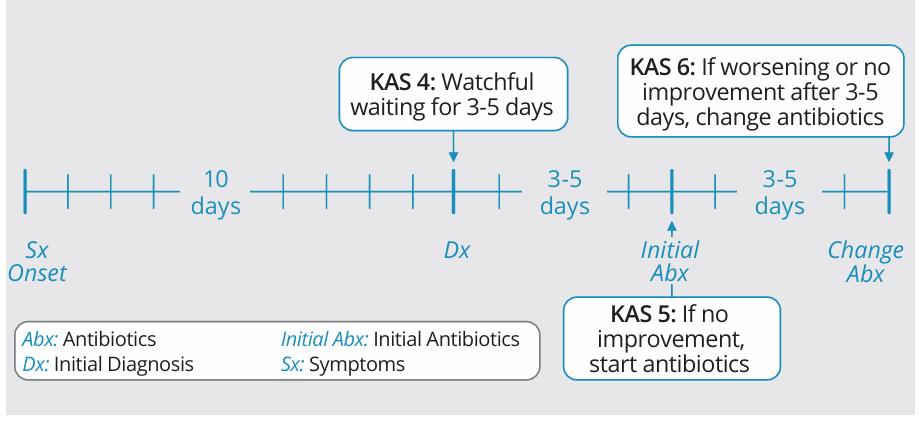
| What is “watchful waiting” for ABRS? | Watchful waiting means delaying antibiotic treatment of ABRS for up to 5 days after diagnosis to see if you get better on your own. |
| How is watchful waiting done? | Your doctor can give you an antibiotic prescription, but you should only fill the prescription and take the antibiotic if you do not get better after 5 days or if you get worse at any time. If you do use the antibiotic, contact your doctor’s office and let them know. |
| If I use an antibiotic, for how many days should I take it? | Antibiotics are usually given for 10 days to treat ABRS, but shorter courses may be equally effective. Ask your doctor about a 5–7 day course of antibiotics since side effects are less common. |
Table 6. Factors That Would Prompt Clinicians to Consider Prescribing Amoxicillin-Clavulanate Instead of Amoxicillin Alone for Initial Management of ABRS
| Factor | Comment |
|---|---|
| Situations in which bacterial resistance is likely |
|
| Presence of moderate to severe infection |
|
| Presence of comorbidity or extremes of life |
|
Table 7. Patient Instructions for Optimal Use of Topical Nasal Steroida
- Shake the bottle well.
- Look down by bending your neck and looking toward the floor.
- Put the nozzle just inside your nose using your right hand for the left nostril and your left hand for the right nostril.
- Aim toward the outer wall and squirt once or twice as directed; do not aim toward the nasal septum (in the middle of the nose) to prevent irritation and bleeding
- Change hands and repeat for the other side.
- Do not sniff hard.
Table 8. Modifying Factors for Adult Sinusitis
| Question | Answer |
|---|---|
| Asthma | Screen for asthma. CRS control including endoscopic sinus surgery may help asthma-related symptoms. |
| Cystic fibrosis | Cystic fibrosis transmembrane conductance regulator (CFTR) modulators have significant impact on CRS treatment and outcomes. |
| Ciliary dyskinesia | Need for high index of suspicion in patient with recurrent pulmonary infections (rare). Confirmatory diagnosis for primary ciliary dyskinesia (PCD) with history, genetic testing, and/or electron microscopy. |
| Immunosuppressive state | Patients with RARS or CRS symptoms and other infectious conditions such as pneumonia, bronchitis, gastroenteritis. Consider treatment with prophylactic antibiotics and vaccination. Consult with allergy/immunology regarding the use of immunoglobulin replacement therapy. |
| Aspirin exacerbated respiratory disease (AERD) | Need for high index of suspicion in patients with severe asthma, early recurrence of disease. Confirmation of diagnosis with strong clinical history of aspirin intolerance and/or aspirin challenge. |
| Other conditions: | |
| Gastroesophageal reflux disease (GERD) / laryngopharyngeal reflux (LPR) | There is an association between CRS and GERD. Proton pump inhibitor (PPI) therapy may improve nasal symptoms and endoscopy, but limited evidence in mild or subclinical disease. |
| Smoking | Smoking increases prevalence of CRS. |
| Bronchiectasis | Greater than 50% of patients with bronchiectasis have CRS. This is associated with poorer quality of life (QOL) and greater disease severity. |
| Depression/ anxiety | Common in CRS patients. May limit the improvement in QOL scores after treatment. |
| Sleep | Rhinologic conditions may lead to mild obstructive symptoms and subjective poor sleep quality. |
Figure 1. Paired Images of the Right Middle Meatusin: an Artist’s View (left) and an Endoscopic View (right)

Figure 2. Endoscopic Image of Edema in the Right Middle Meatus; the Needle Tip Points to the Apex of the Middle Turbinate

Figure 3. Paired Images Through an Endoscope and a Nasal Speculum (circled image) Showing Polyps from the Right Middle Meatus, Filling the Space in the Nasal Cavity Between the Inferior Turbinate (on the left side of the image) and Nasal Septum (on the right)

Figure 4. Symptom Prevalence by Day for Rhinovirus Illness

Figure 5. Adult With Possible Rhinosinusitis
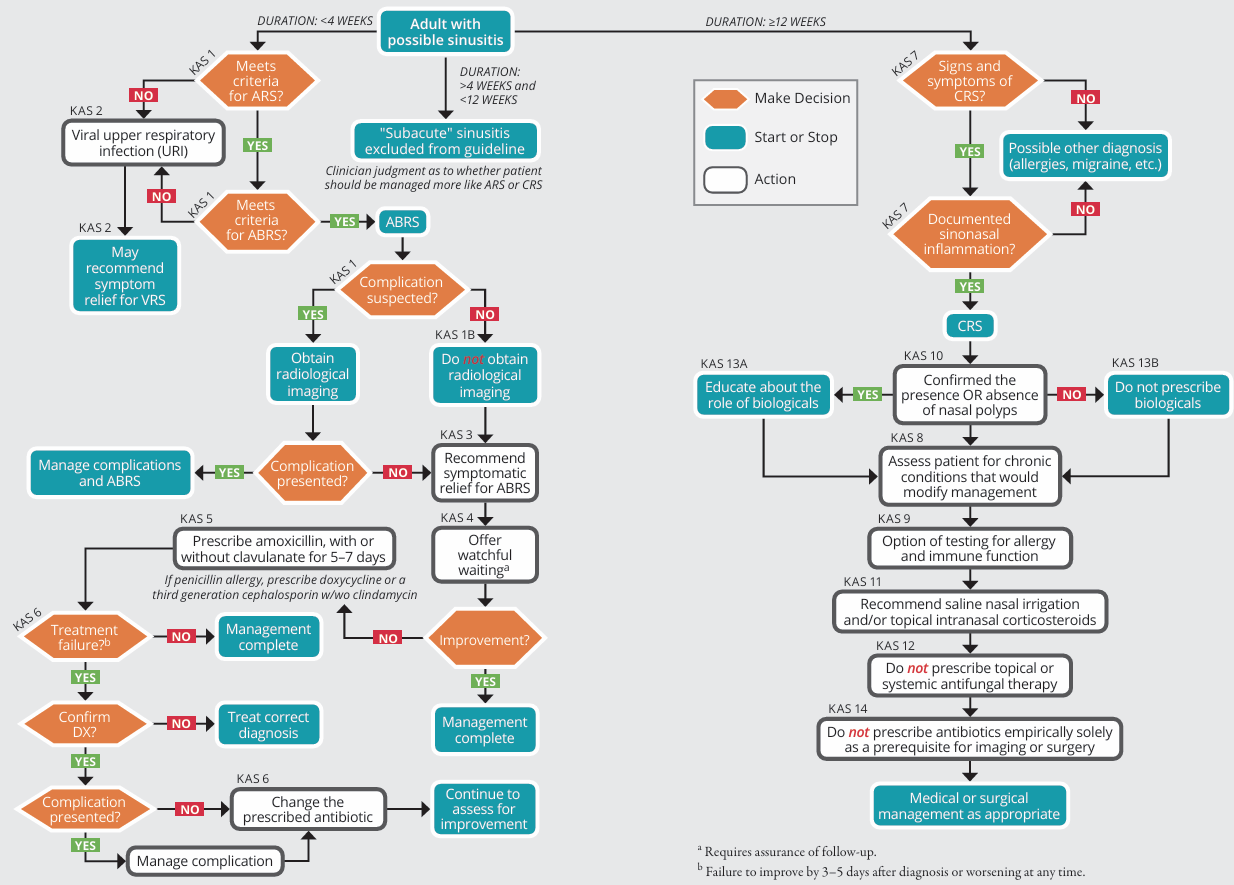
Figure 6. Timeline of Watchful Waiting
Recommendation Grading System
| Grades of Aggregate Evidencea | |||||
|---|---|---|---|---|---|
| Grade | OCBM level | Treatment | Harm | Diagnosis | Prognosis |
| A | 1 | Systematic reviewb of randomized trials | Systematic reviewb of randomized trials, nested case-control studies, or observational studies with dramatic effectb | Systematic reviewb of cross-sectional studies with consistently applied reference standard and blinding | Systematic reviewb of inception cohort studiesc |
| B | 2 | Randomized trials, or observational studies with dramatic effects or highly consistent evidence | Randomized trials, or observational studies with dramatic effects or highly consistent evidence | Cross-sectional studies with consistently applied reference standard and blinding | Inception cohort studiesc |
| C | 3 - 4 | Non-randomized or historically controlled studies, including case-control and observational studies | Non-randomized controlled cohort or follow-up study (post-marketing surveillance) with sufficient numbers to rule out a common harm, case-series, case-control, or historically controlled studies | Non-consecutive studies, case-control studies, or studies with poor, non-independent, or inconsistently applied reference standards | Cohort study, control arm of a randomized trial, case series, or case-control studies, or poor-quality prognostic cohort study |
| D | 5 | Case reports, mechanism-based reasoning, or reasoning from first principles | |||
| X | n/a | Exceptional situations where validating studies cannot be performed and there is a clear preponderance of benefit over harm | |||
a Adapted from Oxford Centre for Evidence-Based Medicine (OCEBM) Work Group.
b A systematic review may be downgraded to level B because of study limitations, heterogeneity, or imprecision.
c A group of individuals identified for subsequent study at an early, uniform point in the course of the specified health condition, or before the condition develops.
| Strength of Action Terms in Guideline Statements and Implied Levels of Obligation | ||
|---|---|---|
| Strength | Definition | Implied Obligation |
| Strong Recommendation | A strong recommendation means the benefits of the recommended approach clearly exceed the harms (or, in the case of a strong negative recommendation, the harms clearly exceed the benefits) and that the quality of the supporting evidence is high (Grade A or B).a In some clearly identified circumstances, strong recommendations may be made based on lesser evidence when high-quality evidence is impossible to obtain and the anticipated benefits strongly outweigh the harms. | Clinicians should follow a strong recommendation unless a clear and compelling rationale for an alternative approach is present. |
| Recommendation | A recommendation means the benefits exceed the harms (or, in the case of a negative recommendation, the harms exceed the benefits), but the quality of evidence is not as high (Grade B or C).a In some clearly identified circumstances, recommendations may be made based on lesser evidence when high-quality evidence is impossible to obtain and the anticipated benefits outweigh the harms. | Clinicians should also generally follow a recommendation but should remain alert to new information and sensitive to patient preferences. |
| Optionb | An option means that either the quality of evidence is suspect (Grade D)a or that well-done studies (Grade A, B, or C)a show little clear advantage to one approach versus another. | Clinicians should be flexible in their decision-making regarding appropriate practice, although they may set bounds on alternatives. Patient preference should have a substantial influencing role. |
a Adapted from American Academy of Pediatrics (AAP) classification scheme.
b Option is similar to the “weak recommendation” used in the Grading of Recommendations Assessment, Development and Evaluation (GRADE) classification.
Abbreviations
- ABRS
- acute bacterial rhinosinusitis
- ARS
- acute rhinosinusitis
- CRS
- chronic rhinosinusitis
- KAS
- key action statement
- RS
- rhinosinusitis
- Rx
- prescription
- URI
- upper respiratory infection
- VRS
- viral rhinosinusitis
Source Citation
Payne SC, McKenna M, Buckley J, et al. Clinical Practice Guideline: Adult Sinusitis Update. Otolaryngol Head Neck Surg. 2025;173(5)(suppl):S1-S56. doi:10.1002/ohn.1344
Expert Authors/Reviewers
Reviewed by:
AAO-HNSF staff and CPG leadership
Disclaimer
This resource is for informational purposes only, intended as a quick-reference tool based on the cited source guideline(s), and should not be used as a substitute for the independent professional judgment of healthcare providers. Practice guidelines are unable to account for every individual variation among patients or take the place of clinician judgment, and the ultimate decision concerning the propriety of any course of conduct must be made by healthcare providers after consideration of each individual patient situation. Guideline Central does not endorse any specific guideline(s) or guideline recommendations and has not independently verified the accuracy hereof. Any use of this resource or any other Guideline Central resources is strictly voluntary.
Guideline Central and select third party use “cookies” on this website to enhance the user experience.
This technology helps us gather statistical and analytical information to optimize the relevant content for you.
The user also has the option to opt-out which may have an effect on the browsing experience.